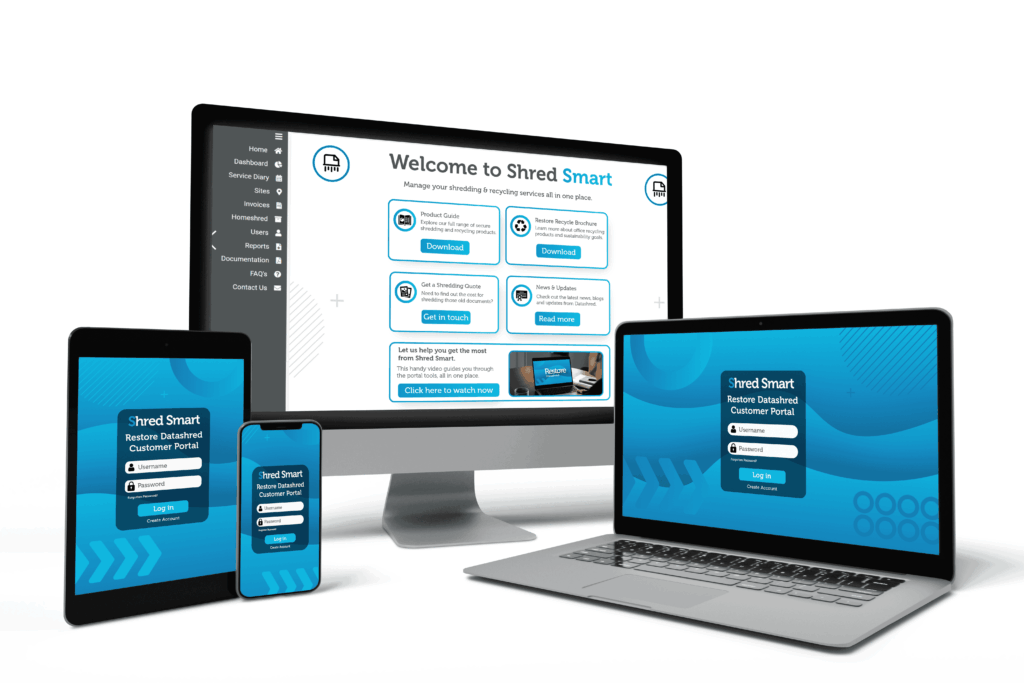
Customer Login

The volume of e-waste chucked in UK landfill or, even worse, illegally dumped each year has passed the tipping point, and is rapidly contributing to making IT assets, mobile telephony and so on the fastest-growing global waste stream. Through Restore Recycle, we can help you find your responsible solution.

Illegal waste mountains
We’ve been writing about the illegal waste mountains across our landscapes for a couple of years – see our latest piece, below, from a month or so ago. While improperly disposed of e-devices are not necessarily the main component of these mountains, the vast quantities of no-longer-needed e-devices generated each year in the UK – a staggering 24kg per person – do accumulate in cupboards, drawers… and landfill. As a nation, we throw away 69% of this obsolete equipment, with little care for where it ends up or for what it might still contain, with this volume increasing by 3-5% per annum.
Find out moreWhy the need for correct disposal?
Environment and ethics
Some of the materials used to manufacture e-devices, highlighted below, are known to be harmful and are highly regulated. Nevertheless, they continue to be found in laptops, smart phones, tablets, servers, and switches, especially in older models, which, if thrown away incorrectly, ie, into the environment, near water sources or sent overseas where they may be dismantled by young children, cause all manner of destruction.

Lead
Still used in amalgam form in the solder on motherboards, in cathode tubes and glass in older equipment, batteries and PVC cable insulation. The World Health Organization (WHO)* deems that no level of lead is safe as it damages neurological development, affects bones and organs, and inhibits growth and reproduction in plants and mammals, kills aquatic life.

Cadmium
Is still used in rechargeable batteries and on motherboards, despite its known damage to bones and kidneys when in raised concentrations.

Mercury
Declining use in lighting, switches and batteries, for example, is down to stricter legislation. Rightly so, since it is a bioaccumulate, concentrating in fish and shellfish, dispersing in vapour into the air. The correct disposal of mercury-containing elements of IT assets helps prevent harms such as cognitive impairment and nervous system damage.

Brominated flame retardants (BMR)
BMR can still be found on plastic housings, on motherboards and in other parts that need protection against fire hazards. Unfortunately, they can persist in the environment if disposed of incorrectly, unleashing their carcinogenic properties and neurotoxicity.
Find out moreHealth harms to people and planet form one pillar of the argument for correct disposal, crucial parts of compliance with the WEEE Directive (2013).There are two further structural elements: IT assets as a ‘seventh resource’, and data protection.

IT assets as the ‘seventh resource’
Quite simply, e-waste should also be disposed of correctly to maximise its use as the ‘seventh resource’, that is, for all the metals, glass, and other recyclable elements that go into manufacturing modern devices to be re-purposed and re-used instead of sent to landfill. Urban mining, for instance, retrieves more grammes of gold, kilo for kilo, from e-waste than is extracted from the mined gold ore. This is valuable financially and ecologically, as recycling decreases the need for virgin resources and the damaging extractive practices required to source them.
Find out more
Data protection
Throwing away electronic devices will not cut it if you are responsible for your, and your customers’, personal information: GDPR law says you are. Security surrounding data isn’t just about paper documents. Any device, including switches, printers and photocopiers, that handles or streams data can be harvested by malpractitioners and hackers seeking to ransom your business and your reputation.
In spite of tight regulation and high levels of GDPR awareness, secondhand devices (up to 48%, according to ICO Research 2024) and disposed hard drives (up to 67%), continue to contain untenable amounts of recoverable data. The law is very clear in just how far your responsibility stretches if you are the owner of discarded equipment that is abused or thrown away in a dump. Failing to dispose of e-devices responsibly, ie, with all data sanitised or destroyed, could spell disaster for your bottom line.
How do we take responsibility?
To be fair, it’s not as if nothing’s been done about it.
The WEEE Directive was made law in 2013, with its core aims of reducing landfill and incineration of electrical goods, including e-devices. Objectives, some of which remain very much ‘work in progress’, include improving product design, producer responsibility, safe handling of hazardous waste, consumer convenience and, of course, the promotion of re-use and recycling. Penalties for non-compliance are steep, with judges and magistrates able to impose unlimited fines for failure to manage e-waste correctly.
The UK government introduced Simpler Recycling in April 2025 which, on the one hand, targets the separation of general waste into recyclable streams for regular collection, and, on the other, increases awareness of the need to be responsible and recycle or dispose correctly of items which are not easily recycled, including e-devices.
On a local level, schemes set up under the Electricals Recycling Fund (£1 million will be distributed by Material Focus in 2026), for instance, aim to encourage recycling of smaller e-devices, such as the millions of mobile phones that get replaced each year, at convenient, accessible and visible drop-off points in everyday locations. Some local authorities, such as West Berkshire, have focused on boosting e-device recycling and seen their rates rise to 55% in 2025 – a significant step up from the 31% nationwide, we think you will agree.
But effecting behavioural change is long-term thinking. Acting now is why Restore Datashred makes it easy and efficient with our specialist division, Restore Recycle.
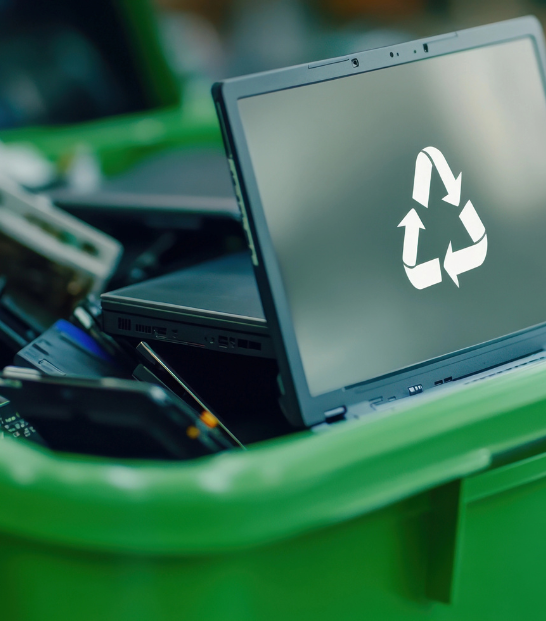
Restore Recycle steps up
Businesses are held to higher standards and levels of legislation than citizens, which is why accreditations and professional disposal firms who DO scruple about responsible disposal are vital to protect your customers’ information, and your reputation.
Backed by our GDPR-compliant systems and processes for secure data destruction that we use for paper and other materials, Restore Recycle goes beyond simple disposal. Offering certified data destruction (GDPR) and ethical e-waste recycling (WEEE Directive), we will ensure that all your responsibilities are given a helping hand and your reputation stays intact.
We meet GDPR compliance with our data sanitisation, hard drive crushing and media destruction methods, all carried out to the highest standards of data security (ISO 27001, NPSA and Cyber Essentials Plus, among others).
Our accreditationsIf the end of support for Windows 10, for example, has meant an estate-wide IT refresh, Restore Recycle can assist with the sustainable decommissioning of:
End-user computing, such as desktops and all-in-ones, legacy peripherals such as keyboards, mice and monitors
Communication and output devices, such as printers and multi-function devices, projectors and interactive displays
Removable media and components, such as magnetic hard drives (HDDs) and solid-state drives (SSDs), memory modules and expansion cards
Mobile and other technologies, including smartphones and PDAs, specialised industrial or scientific equipment contain data storage.

Crisis? What crisis?
For more information about managing your e-waste, speak to one of our customer service colleagues on 0800 376 4422, who will create a bespoke system that works for your business, people and planet.
Get in touchRead more