Customer Login

In a busy, busy world, it’s easy to let the ‘small stuff’ slip to focus on the larger issues staring you in the face. But we all know what can happen next, don’t we?

Like any business or organisation, no matter the size, you have a regular turnover of confidential data in paper and digital formats, and, like any public or private entity, you have legal responsibilities for how you handle that sensitive data and, ultimately, dispose of it.
The Data Protection Act (DPA) first came into force in 1984, so the concept of taking care of customers’ and company information is not new. Since 2018, however, that notion of compliance has been ramped up with the evolution of said DPA into a more far-reaching legal requirement – with stringent penalties for missteps – for comprehensive data protection when it incorporated the EU’s GDPR legislation into UK law.
Compliance is not ‘small stuff’
Financial, commercial, employee and customer details are all important to the continued smooth running of your organisation; schools, hospitals, legal firms, heavy industry, creative collectives, all hold information that matters to someone, whether they have your best interests at heart or not.
Compliance means protecting personal and sensitive data from cradle to grave on behalf of all those with whom you interact on a professional basis by reducing or eradicating any exposure to bad actors, both external and internal. Think of disgruntled employees using commercially sensitive information to exact ‘revenge’ by stealing or making it accessible, or bin thieves who routinely take a deep dive in rubbish to see what they can extract as leverage. Either of these scenarios can lead to reputational damage, loss of customer trust, competitive edge and profit margins. Certainly not ‘small stuff’.
Compliance means not exposing your organisation to exponential risks such as data breaches, identity theft and fraud through sloppy business practices and, for our purposes, should include how you securely dispose of obsolete confidential information. And a crucial factor in keeping those practices tight and fully operational is to make them consistent – regular, timely and cost-efficient.

Instigating good practice
Doing the right thing, adhering to the law, involves taking on board the best practice detailed in the GDPR/DPA 2018 (updated in 2025 to incorporate data sharing and access amendments), the most up-to-date stipulations of which are online at the Information Commissioner’s Office (ICO) www.ico.org.uk and www.legislation.gov.uk.
To be fully compliant, there will inevitably be overlap with the disposal of e-devices as outlined by the WEEE Directive (2013), too, for which all digital data should be securely erased before destruction, whether that’s via shredding or dismantling. Amendments to this legislation in 2025 only emphasise the onus on all of us for handling data and devices responsibly. Planning watertight systems, where there are no gaps for risk to data, should surely be a priority for all organisations, including all those who work flexibly from home, from hot desking offices, from remote offices overseas – the law does not differentiate when it comes to responsibility and who to blame when things go wrong…

Adopting consistency as the key to your planning
We suggest that working with human nature is a great place to start, and systems and processes that are consistent are one of the most important pillars for any business.
Knowing what is to be collected, where to place it, and when it will be collected takes a little colleague education on your part, plenty of appropriately located secure/lockable receptacles for confidential waste, and regular collections of said waste. Making the action of disposing of confidential waste with security in mind second nature or, indeed, part of the furniture (in the case of our secure cabinet bins, designed to blend with your office décor…) is part of the process of risk reduction. This is where Restore Datashred can step up.
How we fit into your plan
Capacity and range: we operate 11 large, modern shredding sites distributed across the UK, and run a 150+ fleet of vehicles, many of them alternatively fuelled, so we have the scope to collect from wherever you are located, from single to multiple sites, including from those who habitually work from home.
Flexibility: witness for yourself your sensitive documents being shredded on-site in one of our high-speed mobile shredding trucks or entrust your materials to being securely transported in a GPS-tracked vehicle to be shredded off-site at one of our destruction centres. We can set up a schedule built around your needs, eg, weekly, monthly, bi-monthly, and once in place, you can relax in the knowledge that your confidential data is not piling up, is not posing a risk of breach or error, and is being securely, professionally destroyed.
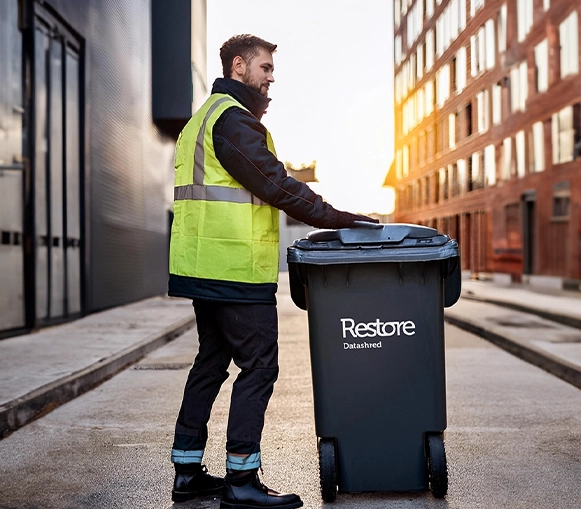
Security: our system is easy to use. We deliver and set up lockable cabinets and bins of the size you need, strategically located for maximum benefit. You and your teams and colleagues place all sensitive data and materials in them and, according to the agreed schedule, one of our security-checked operatives collects to transport the materials either to a mobile shredding truck or off site to one of our CCTV-controlled, password protocoled destruction centres. We supply a certificate of destruction at the end of the transaction. Smooth and easy. The whole chain of custody is e-audited and guaranteed unbroken by our professional experience, certification and accreditations. For additional peace of mind, our modern shredding machines reduce paper documents to fragments within seconds to BS EN15713 standards and we can meet government secrecy requirements, too.
Efficiency: our site and fleet capacity, scheduling expertise and bespoke traffic management software, which enables us to plot the shortest routes, least idling time and most collections per route, allow us to pass on time and cost savings to you, our customer. Regular collections only heighten these savings.
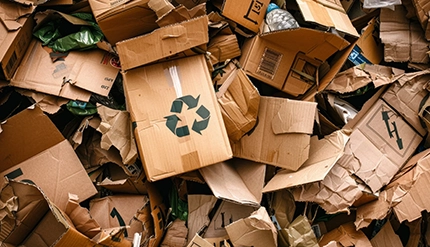
Environmental pluses: on top of our increasingly electrified fleet, PlanetMark™ partnership and further environmental and community initiatives, we guarantee that 100% of the paper you shred with us goes to be recycled into an ever-hungry paper manufacturing industry, who need a consistent, regular supply to meet demand. We also promise not to send other shredded materials to landfill, always seeking alternatives for recycling, re-use and repurpose.
Reiterating the benefits
data breaches
legal hassles
identity theft and fraud
reputational damage
internal misuse
financial penalties
inefficiencies.
Get in touch
Who doesn’t want to knock risk on the head with simple, cost-effective systems that also help reduce environmental impacts? By giving our experienced, approachable team a call on 0800 376 4422, or completing our online form, you are focusing on the ‘small stuff’ to prevent it escalating into a very large headache indeed. We look forward to helping you avoid those pain points.
Get in touchRecent news